As devastating fires have spread across parts of the UK this summer, it’s clear we are already feeling the impacts of climate change. In the media, there is a debate about rewilding. Some have blamed it for the severity of the wildfires. Others have said rewilding is a solution. Who is right?
Let’s look (briefly) at the climate and the weather. Environmentalists’ backlash against talk of a ‘new normal’ is understandable. Firstly, there is nothing normal about the extreme nature of these heatwaves, not just because it’s unprecedented, but also because all the climate modelling says it will get worse than this.
Then there’s the ‘whiplash’ effect. A very wet winter and early spring in the UK supercharged vegetation growth, which then dried out. And became a vast tinder box.
In other words, we have never seen conditions more conducive to wildfire.
There’s also the evidence of where has burnt and why. Contrary to some assertions, the fires at Dunwich Heath were not because this area was rewilded. It’s been managed for conservation for generations. In places like this, conservation charities such as the RSPB, National Trust and The Wildlife Trusts actively restoring wetlands and bogs to retain moisture in the ground, managing the landscape in ways that should restrict the spread of fire, by acting as natural firebreaks.
Rewetting our landscapes
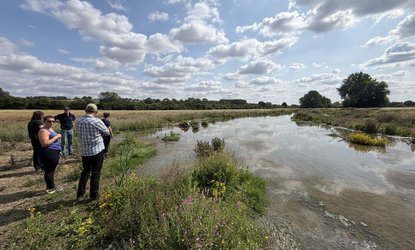
Esmée Fairbairn Foundation has backed a number of schemes that are rewetting landscapes in this way. For example, in the Cotswolds, the Evenlode Landscape Recovery project is creating new ponds and scrapes and putting natural meanders back into watercourses, returning the landscape to natural processes and features that hold more water for longer. Even now, after months without rainfall, you can still see standing water in the Evenlode’s fields and meadows.
Led by a network of farmers, those involved are taking coordinated action to restore the Evenlode catchment, an area at risk of both flooding and drought. By making changes to land use and farming practices, the scheme also aims to generate revenues from improving biodiversity and water quality, reduced flood risk, and carbon sequestration.
By restoring landscapes, nurturing wild habitats, enhancing soil health, and cleansing waterways on a grand scale, farmers will be at the forefront of mitigating the impacts of climate change without sacrificing food production.
North-East Cotswolds Farmer Cluster
The project’s development was initially supported by a grant from Esmée and it has since received significant investment from Defra’s Landscape Recovery programme as well as others including Rebalance Earth, Esmée and private investment.
Similarly, at Heal Rewilding in Somerset, teams have already created new wetland and Ebdon Farm have plans to do so.
A day in the life of a wetland a short video from Heal Rewilding’s site in Somerset
Peat also keeps water in the landscape – on a bigger scale
Just as wetlands help hold water in catchments and floodplains, peatlands store water across entire landscapes. With sphagnum moss the main plant sustaining peatlands, holding twenty times its own weight in water, healthy peatlands help reduce flood risk as well as create buffers to wildfires. The unsung hero of climate action, UK peatlands also store around three billion tonnes of carbon – more than all the woodlands of the UK combined. So, as well as helping us to be more resilient to weather extremes, it’s an investment in climate change mitigation.
In recent years, cross-sector, collaborative action from organisations has become a key driver for peatland restoration. In Northern Ireland, the Peatland Collaborative Network has helped to increase peatland restoration across the nation by supporting member organisations to work together more effectively, share knowledge and expertise. And in England, the Great North Bog, a collaboration of six peat partnerships, is taking a landscape-scale approach to upland peatland restoration and conservation across nearly 7,000 square kilometres, storing 400 million tonnes of carbon.
Moors for the Future are one of the partnerships involved with the Great North Bog, alongside Cumbria Peat Partnership, Lancashire Peat Partnership, North Pennines National Landscape, Northumberland Peat Partnership, and Yorkshire Peat Partnership.
Some commentators who represent grouse shooting interests contend that controlled heather burns are part of the answer to controlling wildfires. Along with Natural England and others, we disagree – we believe the evidence strongly suggests that this kind of burning damages delicate peatland ecosystems while releasing carbon.
Building resilience and investing for the future
With around 80% of UK peatland degraded – through a combination of drainage, agricultural practices, peat cutting and burning – urgent action is needed. Much more investment is needed to restore our peatlands at scale and at speed. We also need to protect our existing peatland, which is why, alongside others including the Peat-free Partnership, we continue to call for Government action to ban the use of peat in all horticultural products. We’re also supporting work by Enrich the Earth, a partnership to accelerate the transition to sustainable, peat-free growing.
It is understandable that people are focusing on fire given the unprecedented events occurring simultaneously across Europe, but climate projections indicate that we will see more extreme rainfall events and that many of the landscapes that are affected by fire now will also be affected by flooding in the future. We need to find opportunities to both hold more water and slow the flow of water through the landscape so that we can build as much resilience as possible in the face of ongoing change. So, we will continue to work with partners to bring the water back into our landscapes and help keep it there – for nature, for climate mitigation and adaptation, and for future generations.