A summary of key actions we have taken during 2025 to make progress on our cross-cutting commitment to diversity, equity, and inclusion (DEI).
Actions are listed under the relevant pillar in ACF’s Stronger Foundations report on Diversity, Equity, and Inclusion. Click on a pillar below to go to that section. To go back to this menu, click the 'back' button in your browser.
- Pillar 1: Invests time and resources in understanding and defining diversity, equity and inclusion
- Pillar 2: Produces and reviews strategies that will implement DEI practices
- Pillar 3: Collects, tracks and publishes DEI data on its own practices and performance
- Pillar 4: Has a diverse Board of Trustees and staff team, both in terms of demographics and experience
- Pillar 5: Reflects and implements DEI practices in its funding activities
- Pillar 6: Expresses its DEI commitment, policies and practices publicly
- Pillar 7: Makes itself accountable to those it serves and supports
- Pillar 8: Uses its own power to advocate for and advance DEI practices
- Pillar 9: Collaborates with others to promote and implement DEI practices
- Actions planned for 2026
Pillar 1: Invests time and resources in understanding and defining diversity, equity and inclusion
- Foundational DEI training: We co-created bespoke DEI training for the staff team with external providers, brap. This will bring a deeper and more nuanced understanding of DEI and how to apply it in the context of our work.
- Intersectional training: We delivered strategy-focused DEI training for the staff team, focusing on intersectional justice, including the intersects between climate justice and racial justice. We also host regular sessions for staff and our Involving Young People Collective to hear from experts and key partners on issues we care about. Last year we heard from Milk Honey Bees, Micro Rainbow and Our Migration Story.
- Racial justice programme: We continued our membership and journey with the Ten Years’ Time Community of Practice, a three-year holistic programme of support and development for funders and charities on their journey towards racial justice. The programme has been designed in response to insights from funders wanting to embed equitable practices, anti-racism, and racial and economic justice.
- Migrant justice: We held a Words Matter workshop for staff focusing on migration communication and inclusivity, delivered by Migrant Rights Network.
- Climate and migration: We took part in a series of learning sessions focusing on the intersects of climate and migration, led by Unbound Philanthropy and The Pickwell Foundation. Sharing learning with other funders helps us to understand and navigate the intersections, nuances and challenges in this work.
Pillar 2: Produces and reviews strategies that will implement DEI practices
- Racial justice: Following a listening exercise with organisations we fund who are led by communities experiencing racial inequity, we shared a report by Chrisann Jarrett reviewing our approach to racial justice along with our initial reflections and actions we plan to take.
- Gender justice: We commissioned a portfolio review of our approach to gender justice, focusing on three key areas: the changing context of this work, the extent to which our current portfolio is meeting its stated outcomes, and how our funding fits within the broader landscape.
Pillar 3: Collects, tracks and publishes DEI data on its own practices and performance
- Diversity of our people: We ran our sixth annual survey of trustees and staff to track diversity progress in terms of gender, ethnicity, disability, age and sexual orientation, and calculate our pay gap. An analysis of our pay gap and actions we’re taking to address them is here.
- Funding data: We shared our 2025 report of who our funding is reaching, which is based on data gathered using the DEI Data Standard. One of our commitments is to fund more organisations led by and for communities experiencing racial inequity. The report shows 25.5% of grants, totalling £11.5m, in 2025 were awarded to organisations led by communities experiencing racial inequity. Our funding increased in 2025, up from a total of £7.8m in 2024 and a total of £9.6m in 2023. On average, grants awarded to led by organisations that experience racial inequity were larger and longer than average grants awarded in 2025.
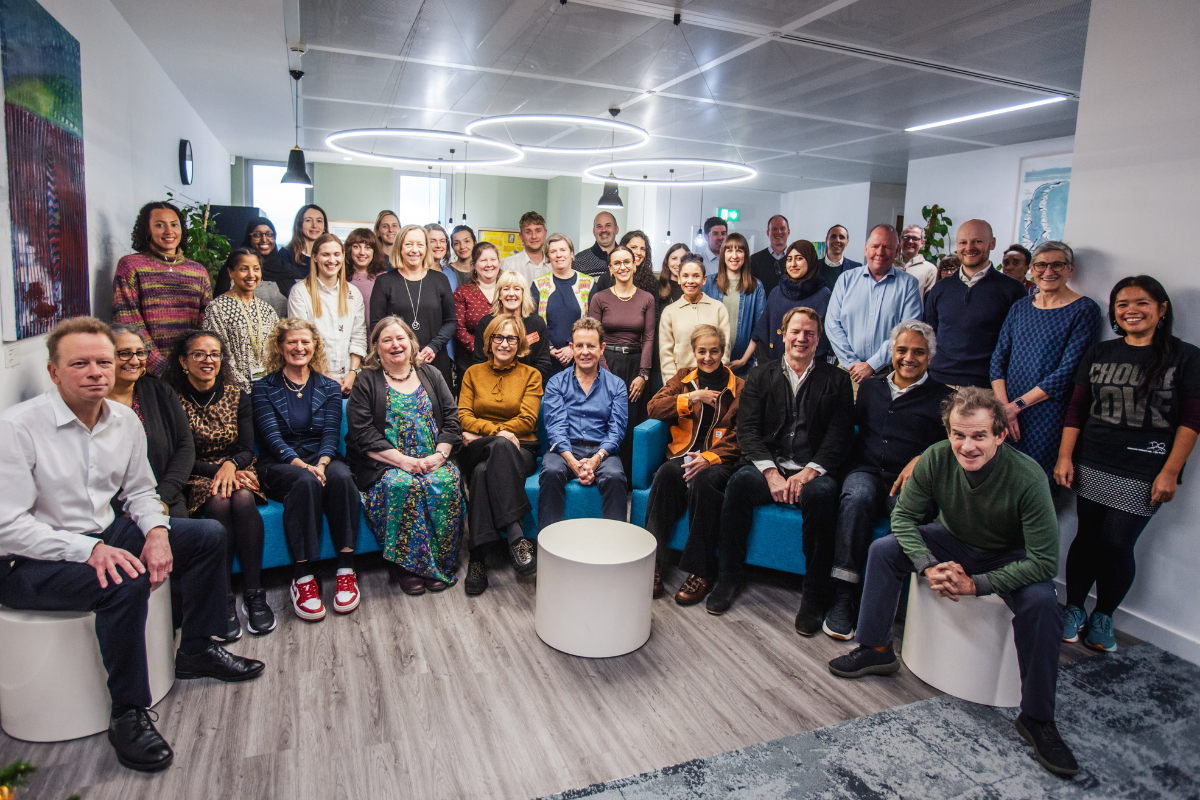
Esmée staff and Trustees
Pillar 4: Has a diverse Board of Trustees and staff team, both in terms of demographics and experience
- Governance: We commissioned an independent review of our governance, which led to a number of recommendations we are taking forward including: moving from a maximum of three terms of office for trustees, to two five-year terms of office; the appointment of a Vice Chair, and a Governance and Nominations Committee to support, oversee and make recommendations to the full Board on issues of governance.
- Staff induction: Based on staff feedback, we have made changes to our induction process to support new colleagues. This includes extending the induction programme, an expanded buddy system, and a sector glossary.
- Wellbeing support for staff: As a member of Ten Years’ Time’s Community of Practice, Global Majority staff are able to attend wellbeing circles with peers from other funders. Separately, we’re also working with Vivify Therapy to support Global Majority staff, and Bird, a specialist resilience and coaching organisation, who have hosted webinars for all staff on topics including imposter syndrome and having courageous conversations.
- Recruitment: We are currently reviewing our approach to recruitment and exploring best practice to help us identify actions to improve our practice. This includes a review of our recruitment partners as well as analysis into diversity data of applicants to ensure that we are attracting individuals with diverse lived and learned experiences to the organisation. We expect to complete this work in 2026.
Pillar 5: Reflects and implements DEI practices in its funding activities
- Wellbeing support for organisations: We have proactively offered 38 wellbeing awards totalling £244,470 in response to challenging events that affect migrants and refugees, trans and non-binary people, and communities experiencing racial inequity. We shared how this funding was used, and what else we and other funders could do to support wellbeing.
- Allyship: We reached out to organisations in our portfolio who have or might be affected by the increase in far-right activity and incidents of racist and anti-migrant violence to offer our support and solidarity.
- DEI assessment framework: We reviewed how we make funding decisions and are developing a framework to support staff on assessing DEI in applicants as well as understand progress on DEI of organisations we fund.
- New Connections: We extended New Connections grants by a year. Through New Connections we are supporting 20 organisations led by, and for, their communities – who could not usually apply to us due to barriers in our process. In 2025 we continued to work with Do it Now Now to offer a programme of peer support and learning, including two residentials.
- Investing for racial equity: We commissioned the Impact Investing Institute, alongside two other funders, to explore investment approaches to support racial equity outcomes in the endowment. That work is ongoing.
- Social and Impact Investing: Through our social and impact investment, we have invested directly in organisations focused on equity and inclusion – both directly into organisations as well as through funds and specialist intermediaries such as The Sumerian Foundation and Kindred LCR (see video below) who provide support for underrepresented social entrepreneurs. We’ve also improved our application processes to be more inclusive, for example by reducing the number of questions at screening stage and enabling applicants to answer via video. Our ongoing work to integrate social investment with our grant-making processes has also allowed us to bring a wider range of lived and worked experience into our assessments and promote social investment to lived-experience-led organisations in our grants portfolio. The Advocacy Academy and Rekindle are examples of lived experience-led youth justice organisations that we have supported with social investment.
- Access payments: We continue to provide accessibility support to applicants by making Access payments, approving 13 payments during the year.
A short film about Kindred LCR, featuring socially-trading organisations (STOs) they have supported.
Pillar 6: Expresses its DEI commitment, policies and practices publicly
- Commitment to DEI: We continue to publicly share updates and report our progress on our commitments, including through this report.
- Social Investment: We signed the Diversity Forum’s Manifesto 2.0, which includes seven commitments to improving DEI in the social investment sector. As part of this, we have been working to better understand who our social investment funding is reaching and what more we can do to increase inclusion.
Pillar 7: Makes itself accountable to those it serves and supports
- Application guidance: We delivered three webinars to support applicants through our process, and to be more transparent and open to challenge. These webinars were attended by over 1000 people. We use BSL interpretation as standard.
- Responding to feedback: We shared actions we have taken to address the key findings of research into what applicants and organisations we fund think of us.
- Funding criteria: As a result of feedback and learning through our New Connections programme, we made a change to our longstanding criteria for governance, explaining how we look for evidence that the organisation is led and governed accountably and well, rather than imposing one-size-fits-all limits on organisational and governance structures.
Pillar 8: Uses its own power to advocate for and advance DEI practices
- Funding Plus DEI support: We published research that we commissioned to review DEI support accessed by organisations we fund through Funding Plus, and case studies to help anyone looking to commission or embark on similar work. We hosted a webinar to present and discuss the findings.
- The RACE Report: We have supported the RACE Report, a transparency initiative to encourage action in the environment sector towards diversity, equity and inclusion, with longer term funding and are working with grant recipients to encourage them to engage with the initiative. We have also participated in the Report since its inception. We shared our reflections on the RACE Report as well as our own progress in early 2026.
Pillar 9: Collaborates with others to promote and implement DEI practices
- Supporting lived experience: Together with Peer Power Youth and Place Matters, we published a report, Supporting employees with lived experience, sharing learning from 24 social impact organisations which was developed from a peer learning group. We have conducted two follow-up sessions with staff team to understand how to apply learning and recommendations around supporting and valuing lived experience in our work. We’re also working with ACF to host a community of practice for the sector.
- Diversifying leadership: We have been working with Common Purpose and Makani Cambridge to co-design and pilot a new senior leadership programme, Reimagining leadership in the environment sector, which aims to support a more equitable and diverse sector.
Actions for 2026:
- We will deliver our new foundational DEI programme to Esmée staff in early 2026, including bespoke training on neurodiversity.
- We will reflect on and share learning from the New Connections programme.
- We will reflect on the Supporting Employees with Lived Experience report and recommendations to apply learning and inclusive practices to our work.
- We will share a report on the DEI Data Standard.
- We will update on the actions that we committed to in response to the Racial justice review and share our next steps.